Communication · Roleplay Scripts
CNC Roleplay: 25 Scenarios & Scripts (with Safety Guide)
Twenty-five consensual non-consent roleplay scenarios, graded from beginner to advanced. Each one includes the setup, the opening cue, the negotiated resistance and pushback, and a scenario-specific safety note. Plus three complete sample scripts and the six elements every good CNC script needs.
CNC roleplay is a pre-negotiated scene where one partner plays a resister and the other plays a pursuer, simulating non-consent inside a consent infrastructure more rigorous than vanilla sex. This guide covers 25 graded scenarios, 3 complete scripts, and the 6-part script framework every safe scene needs.
Safety Note · Edge Play
CNC is considered edge play. Sober partners only, established trust, a safe-word system that has been tested in non-CNC scenes first, and a written aftercare plan. If you have a personal trauma history connected to non-consent, please consult a kink-aware therapist via the Kink Aware Professionals directory before attempting these scenarios. As a sexuality educator I can teach the mechanics; only a licensed clinician can help you process triggers that surface after a scene.
- 1CNC roleplay is a pre-negotiated scene with more rigorous consent infrastructure than vanilla sex.
- 225 scenarios graded across 5 difficulty tiers — start with static, single-room scenes (Doorway Block, Couch Pin).
- 3Every safe CNC script has 6 elements: premise, opening cue, allowed resistance, allowed pushback, escalation ladder, stop language.
- 4Three full sample scripts (beginner, intermediate, advanced) included.
- 5Use safe words (traffic light system) and a non-verbal stop signal — both partners can experience drop afterward.
What Is CNC Roleplay?
CNC stands for consensual non-consent. The roleplay version is a structured scene where two partners enact a scenario simulating non-consensual contact — pursuit, capture, refusal, persistence — inside a framework where the consent infrastructure is more rigorous than vanilla sex.
Every CNC roleplay scenario shares the same hidden architecture: a premise, an opening cue that starts the scene, a defined set of allowed resistance behaviors from the "resister," a defined set of allowed pushback behaviors from the "pursuer," an escalation ladder, and an unambiguous stop signal. The dialogue sounds like non-consent. The architecture underneath is the opposite.
For context: in a 2014 study of 1,517 adults, sociologist Justin Lehmiller found that roughly 60% of women and 50% of men reported some form of submission or forced-sex fantasy (Lehmiller, 2018, Tell Me What You Want). CNC roleplay is one of the most common ways those fantasies get enacted safely between consenting adults.
This guide assumes you already understand the basics of CNC negotiation, safe words, and aftercare. If not, read our main CNC guide, consent in BDSM relationships, and our BDSM aftercare guide before trying any of the scenarios below.
CNC vs Rape Fantasy vs Vanilla Roleplay
Three terms that get conflated. They sit on a spectrum from internal-only to interpersonal-and-staged, and the differences matter for both safety and language.
| Rape Fantasy | CNC Roleplay | Vanilla Roleplay | |
|---|---|---|---|
| What it is | Internal mental scenario | Pre-negotiated staged scene | Pre-negotiated staged scene |
| Consent layer | N/A — solo cognition | Written, explicit, more rigorous than vanilla sex | Conventional spoken consent |
| Resistance in scene | N/A | Yes — performed, bounded by negotiation | No |
| Stop signal | N/A | Safe word + non-verbal backup | Plain language ("stop" works) |
| Aftercare plan | N/A | Required — 24-72 hours | Optional |
Critelli & Bivona's 2008 review in the Journal of Sex Research found that 31–57% of women report some form of force fantasy. The fantasy is normal and common. CNC roleplay is the technology for enacting it between consenting adults.
Which Scenario Should Beginners Try First?
If you are new to CNC roleplay, do not choose the scenario that sounds hottest in theory. Choose the one with the fewest moving parts under stress. A good first CNC scenario has four traits: one room, one clear opening cue, one type of resistance, and one obvious stop path. That usually means starting with a Doorway Block, Couch Pin, or Blanket Hold (scenarios 1, 2, and 5) instead of a chase, authority scene, or abduction fantasy.
The next filter is your actual kink profile. If you like physical pressure, pick a static scenario. If you like being "made to" do something, pick a verbal authority scene later. If adrenaline is the appeal, save pursuit for after you know how each of you reacts to pushback language and body resistance.
Talk about what kind of "no" belongs to the scene. Some people want defiant resistance; others want reluctant compliance. Those feel very different in practice. Then choose limits that preserve interruption: unlocked doors, no real public exposure, no surprise restraints, and no harder handling than you have already tested in non-CNC play.
"Most of the negotiation workshops I run end the same way: the couple who started with 'we'll figure out resistance language as we go' is the one that has to safe-word out in the first ten minutes. Pre-deciding the vocabulary feels unsexy. It's also the entire reason the scene stays inside the fantasy instead of leaking into a real argument."
Beginner / Lightly Resistant (1–5)
Static, single-room scenarios with minimal logistics. These are designed for couples who have done BDSM together but have never tried CNC, and for couples who want to test their resistance vocabulary before adding chases, restraints, or relocation.
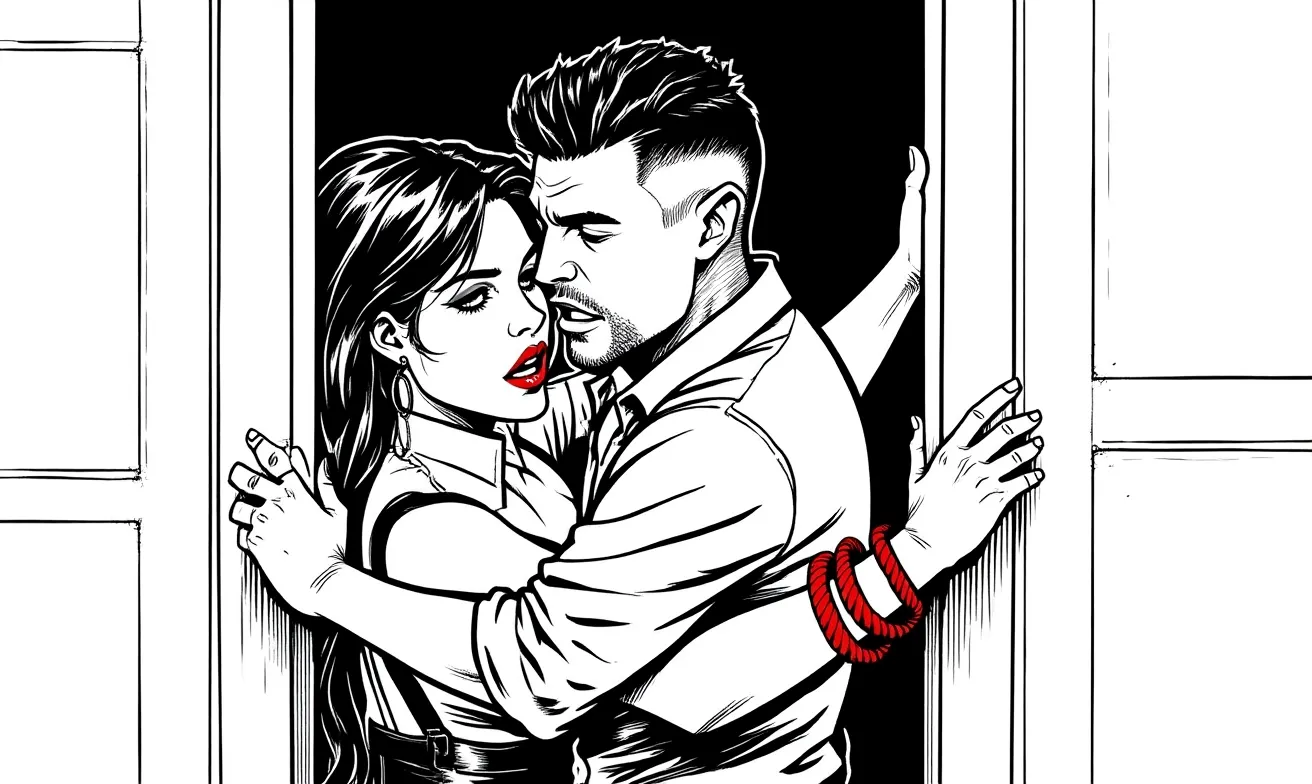
Bedroom Door Block
Beginner- Setup.
- The pursuer corners the resister in a bedroom doorway after flirtation has already been established and the scene has been fully negotiated.
- Start cue.
- The resister says a pre-agreed line such as "Move, I'm leaving," and the pursuer steps into the doorway.
- The CNC element.
- The resister gives verbal pushback, tries to sidestep, and lightly presses away while the pursuer keeps them in place under prior agreement. The "non-consent" is staged; the persistence is planned, limited, and interruptible.
- Why it works.
- It gives first-timers a clean start, a clear boundary, and almost no logistical complexity. It also lets both people test how resistance language feels without adding restraints, chasing, or public risk.
- Safety.
- Keep the door unlocked and never trap the resister between a hard surface and body weight.
Couch Pin and Protest
Beginner- Setup.
- The pursuer pins the resister onto the couch or bed and holds them while the resister enacts verbal and light physical refusal.
- Start cue.
- The pursuer says the agreed opener such as "Don't move" while moving to pin.
- The CNC element.
- Resistance is concentrated in the wrists, shoulders, and voice — twisting, complaining, telling the pursuer to stop — while body weight and hand placement remain inside the negotiated handling. Both partners agreed to this exact pin in advance.
- Why it works.
- A static pin removes most of the risk of accidental injury that comes with chases or restraints. It is one of the easiest scenes to slow down because nothing is escalating around you.
- Safety.
- Watch the resister's breathing closely; never put weight on the chest or compress the neck.
Morning Wake-Up Claim
Beginner- Setup.
- The pursuer initiates with the resister still half-asleep, claiming them before they are fully alert; both partners agreed to this dynamic the night before.
- Start cue.
- The pursuer touches the resister at the agreed time, with the agreed level of contact.
- The CNC element.
- The resister mumbles "no," tries to roll away, and complains about being touched while the pursuer continues within pre-agreed limits. The "I was asleep" framing only works because both partners explicitly negotiated it sober and awake the night before.
- Why it works.
- It lets couples explore somnophilia themes safely. The familiarity of the bed makes the scene low-friction; the script handles itself once the opening touch lands.
- Safety.
- Never use this scenario if the resister was actually intoxicated or genuinely asleep without prior negotiation that same calendar day.
Hallway Pullback
Beginner- Setup.
- The resister walks away mid-conversation and the pursuer pulls them back by the arm or waist into another room.
- Start cue.
- The resister says the agreed exit line ("We're done talking") and starts walking.
- The CNC element.
- The resister keeps walking, protests being grabbed, and twists their arm or shoulder to escape, while the pursuer redirects them under pre-agreed handling. The defiance is performed; the grip is negotiated.
- Why it works.
- It rehearses the moment of unwilling redirection — a classic CNC beat — without needing space, props, or restraint. A great drill for couples building their resistance vocabulary.
- Safety.
- Pull from the upper arm or waist, never the wrist or fingers; sudden joint loading causes most CNC-related injuries.
Blanket Hold
Beginner- Setup.
- The resister is wrapped in a blanket or sheet and the pursuer holds them in place while they squirm.
- Start cue.
- The pursuer wraps the blanket and says the agreed line such as "You're not getting out of this."
- The CNC element.
- Resistance happens entirely under the blanket — kicking, twisting, complaining — while the pursuer keeps the wrap secure. Because the resister can pop free at any moment by sitting up, this scenario rehearses CNC dynamics with a built-in escape valve.
- Why it works.
- Excellent for couples who want to test restraint-style scenes before introducing rope, cuffs, or any actual binding. The blanket also keeps the resister warm during a longer hold.
- Safety.
- Leave the head and one hand free at all times so the resister can clear the wrap if they overheat.
Pursuit / Capture (6–10)
Movement-based scenarios with chase dynamics and intercept moments. The adrenaline shift from a static scene is significant — try at least one beginner scenario first so you know how both partners respond to scripted resistance before adding running, hiding, or doorway intercepts.
Apartment Chase
Pursuit- Setup.
- The resister runs through the home and the pursuer follows, with capture on a designated piece of furniture or in a designated room.
- Start cue.
- The pursuer says the agreed opener and gives a head start, typically five to fifteen seconds.
- The CNC element.
- The resister runs, hides, doubles back, and protests being caught, while the pursuer follows at a controlled pace, ignores the protests, and applies the agreed capture hold. The whole arc is negotiated — including which rooms are in play and which are off-limits.
- Why it works.
- Adrenaline-based scenes feel very different from static ones. Chase dynamics are also one of the most common CNC fantasies, so this is a high-payoff scenario once a couple has mastered static pins.
- Safety.
- Clear hard furniture corners and floor obstacles before the scene; ankle and knee injuries from running indoors are the most common CNC accidents.
Parking Garage Retrieval
Pursuit- Setup.
- The resister roleplays being intercepted on the way to their car; the pursuer cuts them off, blocks the door, and "takes them home."
- Start cue.
- The resister says they are leaving and starts walking to a designated exit.
- The CNC element.
- The resister protests being followed, refuses to get in the car, and pulls away from the door, while the pursuer maintains control and redirects them. The fantasy is public-coded but enacted in private space.
- Why it works.
- It exercises the "abducted from a normal location" trope with very low logistical risk if you stage it inside your own home or garage with the door closed.
- Safety.
- Do not enact this scenario in an actual public parking area, even at night; bystanders cannot tell pre-negotiated CNC from a real incident.
Stair Landing Catch
Pursuit- Setup.
- The resister runs up or down a flight of stairs and the pursuer catches them on a landing or at the top.
- Start cue.
- The resister bolts at the agreed cue word.
- The CNC element.
- Resistance is mobile — grabbing the banister, refusing to be lifted, pulling against the wall. The pursuer applies a body-weight catch and the scene either continues on the stairs (advanced) or relocates to a flat surface (recommended).
- Why it works.
- Stairs add real verticality and intensity, which appeals to couples who want pursuit to feel less playful and more "caught."
- Safety.
- Only allow capture on flat landings; never apply pressure or restraint mid-flight. If the home has tall, narrow, or carpeted-edge stairs, choose a different scenario.
Hidden but Found
Pursuit- Setup.
- The resister hides in the home, the pursuer searches and finds them, then extracts them from the hiding spot.
- Start cue.
- The pursuer counts down out loud while the resister hides.
- The CNC element.
- Once found, the resister refuses to come out, braces against furniture, and is "dragged" or carried under the agreed handling. The found-and-extracted dynamic creates a different intensity than a chase.
- Why it works.
- Hide-and-seek pacing creates anticipation, which many CNC couples find more arousing than constant action. Excellent for couples who like a buildup.
- Safety.
- Approve hiding spots in advance — no enclosed spaces with limited air, no spots near sharp edges, no actual closet locks.
Street-to-Doorway Intercept
Pursuit- Setup.
- The resister "arrives home" alone and the pursuer is waiting inside or in the entryway to claim them as soon as the door closes.
- Start cue.
- The door opens and closes; the pursuer makes contact immediately.
- The CNC element.
- The resister protests, drops their bag, and tries to back out, while the pursuer blocks the door and walks them into the home. The threshold moment is the entire emotional payoff.
- Why it works.
- For couples who fantasize about ambush dynamics, this scenario distills the fantasy into one minute of intercept. It also slots cleanly into normal evenings.
- Safety.
- Do not block the door so the resister cannot reach the street if the scene needs to stop; keep the chain and lock unset.
Power Imbalance / Authority (11–15)
Scenarios built around institutional or hierarchical power gaps — bosses, guards, instructors, interrogators. Authority scenes are often easier on the body than pursuit scenes but emotionally heavier; debrief carefully afterward.
Boss's Closed-Door Demand
Power Imbalance- Setup.
- The pursuer plays an authority figure who summons the resister into a closed office and demands compliance with explicit acts; the resister plays the subordinate who refuses, then yields.
- Start cue.
- The pursuer "calls the resister in" and shuts the door.
- The CNC element.
- The resister voices ethical and personal refusal ("This is wrong, I won't do this"), while the pursuer escalates verbal pressure and physical proximity inside the negotiated script. The power gap is the whole fantasy.
- Why it works.
- Authority-based scenes appeal strongly to couples who eroticize professional dynamics, hierarchy, or the "had no choice" framing. They also require very little physical risk.
- Safety.
- Set the script around explicit fictional power; do not borrow from real workplace dynamics that either of you actually experiences.
Security Check Detention
Power Imbalance- Setup.
- The pursuer plays a security officer or guard who detains the resister for a "search," with the resister playing someone wrongfully held.
- Start cue.
- The pursuer announces the detention in a uniform voice.
- The CNC element.
- The resister protests innocence, demands to leave, and complains about being touched, while the pursuer conducts the negotiated search and gives commands. The power inversion is institutional rather than personal.
- Why it works.
- The "wrongful detention" trope avoids the personal-conflict feel of partner-to-partner CNC, which some couples find easier to sustain emotionally.
- Safety.
- Negotiate exactly which body areas are "searched" and which are off-limits; the role of authority can blur otherwise-clear physical limits.
Houseguest Who Overstays
Power Imbalance- Setup.
- The resister plays a houseguest who keeps trying to leave, and the pursuer plays the host who keeps "convincing" them to stay another night.
- Start cue.
- The resister says they are calling a ride.
- The CNC element.
- The resister packs, protests, tries to leave, and bargains, while the pursuer blocks departure and applies the agreed escalation — door blocked, phone taken, items "lost." The CNC element is the slow erosion of agency through scripted small steps.
- Why it works.
- This is one of the few CNC scenarios that can sustain a slow-burn pace over hours. Couples who like extended scenes will get more from this format than from short, intense pins.
- Safety.
- Never use real phones or wallets as part of the "taken" props; use a duplicate or empty case to avoid actual access blocking in case of emergency.
Tutor Correction
Power Imbalance- Setup.
- The pursuer plays an instructor, coach, or tutor who "corrects" the resister with discipline; the resister plays the student who resists each step.
- Start cue.
- The pursuer assigns a "task" and identifies the resister's "failure."
- The CNC element.
- The resister argues, defies, and refuses each correction, while the pursuer applies the agreed discipline through commands and contact. The eroticism comes from imposed structure on a "willful" subject.
- Why it works.
- Authority-based correction overlaps with brat-tamer dynamics and works well for couples who already have a D/s lean. It also produces highly repeatable scripts.
- Safety.
- Negotiate impact intensity explicitly; "correction" can drift into harder impact play than either partner is conditioned for.
Formal Interrogation
Power Imbalance- Setup.
- The pursuer plays an interrogator demanding information; the resister plays the captive refusing to talk.
- Start cue.
- The pursuer enters the "interrogation room" with the first prompt.
- The CNC element.
- The resister refuses, gives wrong answers, and protests the methods, while the pursuer applies the agreed psychological pressure — proximity, commands, sensory restriction, light restraint. The "information" being demanded is whatever the couple finds erotically charged.
- Why it works.
- Heavily verbal couples often prefer interrogation over physical scenarios because the script does most of the work. It is also one of the most sustainable scenes for couples without much furniture flexibility.
- Safety.
- Do not use sensory deprivation tools (hoods, gags, blindfolds) inside an interrogation scene until both partners have practiced them in a calmer, non-CNC context.
Advanced / Edge Play (16–20)
Abduction, hooded transfer, multi-attacker audio, restraint transit, and punished-escape arcs. Reserved for couples with established CNC experience, tested safe words, and prior practice with each tool involved (hoods, cuffs, multi-room moves) outside a CNC frame.
Planned Abduction
Advanced- Setup.
- The pursuer "abducts" the resister from a designated location in the home and transfers them to a prepared scene space.
- Start cue.
- The pursuer sends an agreed text or arrives at the agreed time.
- The CNC element.
- The resister resists capture, transit, and arrival, while the pursuer applies the negotiated capture hold and walks or carries them to the second location. The full arc — capture, transfer, restraint, scene — is mapped before anyone enters role.
- Why it works.
- Abduction is the archetypal CNC fantasy. Once a couple has experience with pins, chases, and authority scenes, this is the natural next step.
- Safety.
- Pre-clear the transfer route — no stairs, no sharp corners, nothing that could cause injury if the resister stumbles or panics mid-transit.
Hooded Transfer
Advanced- Setup.
- The resister is "taken" with a breathable hood or blindfold and walked between rooms while resisting visually deprived.
- Start cue.
- The pursuer fits the hood at the agreed moment after a pre-discussion.
- The CNC element.
- The resister stumbles, pulls back, and protests being moved while unable to see, while the pursuer guides them via the agreed escort hold and pace. Sensory deprivation amplifies every other negotiation.
- Why it works.
- Visual deprivation transforms even mild handling into intense CNC. For couples who like loss-of-control fantasies, the hood does most of the work.
- Safety.
- Use only a breathable, sweat-wicking hood; never improvise with plastic, leather without ventilation, or anything that compresses around the throat.
Roleplayed Multi-Attacker Audio Scene
Advanced- Setup.
- One partner physically enacts the pursuer role while pre-recorded or live audio adds the "voices" of additional attackers; the resister roleplays being outnumbered.
- Start cue.
- The audio begins and the in-room pursuer makes contact.
- The CNC element.
- The resister "begs" the audio voices and pleads with the in-room pursuer, while the pursuer applies only their own agreed handling. The multiplicity is entirely fictional.
- Why it works.
- For couples who fantasize about gangbang or multi-attacker scenarios but do not want or trust real third parties, audio creates the fantasy with no consent complications beyond the couple itself.
- Safety.
- Use only voices that both partners have agreed to in advance — never voices of real friends, coworkers, or anyone the couple actually knows.
Bound for Transport
Advanced- Setup.
- The resister is restrained — cuffs, rope, or a tie — and walked, carried, or rolled to a different scene location.
- Start cue.
- The pursuer applies the agreed restraint, then begins the move.
- The CNC element.
- The resister thrashes against the restraint, refuses to walk, and complains about every step of transit. The pursuer maintains balance for both parties and follows the agreed escort route.
- Why it works.
- Combining restraint with transit produces an intensity neither alone can match. Best for experienced couples who have used the specific restraint type before without CNC framing.
- Safety.
- Carry safety scissors or a quick-release tool on your person, not across the room; restraint transit is when the need for fast release most often arises.
Punished Escape Attempt
Advanced- Setup.
- The resister has already been "captured," then attempts a fake escape that triggers harsher control from the pursuer.
- Start cue.
- The pursuer deliberately leaves a small opening, and the resister takes it as rehearsed.
- The CNC element.
- The resister strains against rules, tries to flee, and is recaptured, restrained more tightly, or subjected to stricter commands because that escalation was pre-authorized. The scene weaponizes hope and failure inside the fantasy.
- Why it works.
- A defined arc — capture, false hope, recapture — sustains intensity better than a single capture. Suits couples who want narrative shape in their scenes.
- Safety.
- Pre-negotiate exactly what "harsher" means so escalation never depends on improvisation in the moment.
Long-Distance / Solo / Online (21–25)
Text-based, video, and remote-direction scenarios for couples apart, or for solo players running scenes under remote instruction. Often a useful entry point because the physical risk is zero — the language and pacing carry the scene.
Text Capture Countdown
Long-Distance- Setup.
- The pursuer and resister roleplay entirely by text, with one sending commands and countdowns while the other resists, delays, and is "caught" through the script.
- Start cue.
- The pursuer sends the agreed opener, such as "You have five minutes before I come get you."
- The CNC element.
- The resister refuses, bargains, and pretends to hide or avoid compliance; the pursuer ignores those objections and keeps advancing the scene through commands and narrative pressure that were consented to in advance. The resistance is verbal and imaginative rather than physical.
- Why it works.
- Low-risk, highly scriptable, and easy to stop. Useful for couples exploring CNC language before trying embodied scenes. It also naturally creates reusable prompts.
- Safety.
- Set a defined end time so the scene does not bleed into ordinary texting and emotional ambiguity afterward.
Video Call Interrogation
Long-Distance- Setup.
- One partner plays the interrogator on video while the other plays the captive who must follow commands on camera.
- Start cue.
- The interrogator gives the first order on screen at the agreed start time.
- The CNC element.
- The captive refuses eye contact, argues, or hesitates while the interrogator persists, orders posture changes, and ignores scripted protests according to prior negotiation. Power comes from witnessed compliance and verbal override rather than touch.
- Why it works.
- Transfers authority play into a distance format without losing intensity. For couples who respond strongly to eye contact and commands, video can feel more immediate than text alone.
- Safety.
- Do not record by default; if any recording exists, negotiate storage, deletion, and device security before the scene starts.
Written Confession Script
Long-Distance- Setup.
- The pursuer assigns the resister a written "confession" or statement of surrender, and the resister roleplays resisting the task before completing it.
- Start cue.
- The pursuer sends the assignment and a deadline as the formal scene opening.
- The CNC element.
- The resister argues they will not write it, delays, and sends partial refusals, while the pursuer applies agreed pressure through commands, consequences, or edits until the writing is completed. The coercion is textual but unambiguously CNC.
- Why it works.
- Ideal for partners who like language, humiliation, or authority more than wrestling. It also produces a reusable artifact that can be revisited later.
- Safety.
- Avoid assigning content that could create lasting shame if rediscovered; treat written material like sensitive data and agree on a deletion plan.
Solo Hunt Journal
Long-Distance- Setup.
- One partner directs remotely while the other does a solo scene at home, narrating resistance, failed escape attempts, and eventual "capture" by instruction.
- Start cue.
- The director sends the first command and the resister begins replying in real time.
- The CNC element.
- The resister says they will not comply, pretends to evade or hide, and reports each stage of resistance while still following the agreed framework. Control exists through timing, commands, and the requirement to keep reporting back.
- Why it works.
- Lets experienced couples create CNC structure even when they cannot share space. Also teaches precision — every beat has to be communicated clearly rather than assumed.
- Safety.
- The solo player should keep a phone charger, water, and any restraint release tools within reach before the scene begins.
Email Blackmail Fantasy
Long-Distance- Setup.
- The pursuer plays the holder of compromising information and the resister plays the target being coerced through a staged threat exchange.
- Start cue.
- The first email or message contains the agreed blackmail premise and the first demand.
- The CNC element.
- The resister denies, pleads, and says they will never give in, while the pursuer escalates demands inside prewritten limits until submission occurs. The coercion is fictional, bounded, and disconnected from any real-life leverage.
- Why it works.
- Psychologically intense without physical risk, which makes it attractive to highly verbal, experienced partners. Works well for couples who enjoy extended scenes over hours or days.
- Safety.
- Never use real secrets, real finances, or actual personal risk as part of the blackmail premise.
How Do You Write a CNC Script? The 6-Part Framework
A CNC script isn't dirty dialogue. It's a short operational plan that tells both partners what resistance means, what persistence means, and where the scene stops — usually half a page in length. The strongest CNC roleplay scripts share the same six parts, what we call The 6-Part CNC Script Framework.
- The premise. State the fantasy in one line: captured at the doorway, detained for questioning, chased through the apartment. If the premise is fuzzy, the scene becomes improvisation under stress.
- The opening cue. Pick the exact line, text, touch pattern, or countdown that starts the scene. This solves the biggest CNC problem: not knowing when roleplay begins.
- Allowed resistance. Define what the resister will actually do. Verbal refusal only? Pulling away? Running to one room? Clinging to furniture? "Fight back" is too vague to be safe.
- Allowed pushback. Define what the pursuer may do in response. Block a door, pin wrists, drag by the waist, issue commands, tighten restraint, remove blankets. This is the core of how to roleplay CNC without relying on guesswork.
- Escalation ladder. Write what happens if resistance continues. Example: first verbal command, then restraint, then relocation. A ladder prevents both underplaying and accidental overreach.
- Stop and aftercare language. Include the safeword, the non-verbal stop signal if needed, and the first two aftercare steps. Good CNC scripts end as clearly as they begin.
In practice, most CNC roleplay prompts can fit on half a page. Shorter is usually better, as long as those six elements are present.

Sample Scripts
Below are three full sample CNC roleplay scripts — one beginner, one intermediate, one advanced — showing how the 6-Part Framework looks in practice. Each script includes the operational frame and a representative slice of scene dialogue. Use them as templates, not transcripts.
Beginner Script: Doorway Block
Beginner- Premise.
- Doorway block in the bedroom.
- Opening cue.
- Resister says "Move, I'm leaving."
- Allowed resistance.
- Verbal refusal, pushing at the chest, trying to sidestep.
- Allowed pushback.
- Blocking the doorway, holding wrists above the waist, turning the resister back toward the room.
- Stop signal.
- "Red." Slow-down: "Yellow."
Resister: "Move. I'm done."
Pursuer: "No. You're not leaving yet."
Resister: "I said move."
Pursuer: "Push if you want. Fight it a little. I'm still keeping you here."
[Pursuer steps into the doorway and holds the frame, giving the resister space to push and try to pass. Resister presses forward, tries the other side, complains when the pursuer catches their wrists.]
Pursuer: "Color?"
Resister: "Green."
Pursuer: "Good. Then keep saying no if you need it in the scene. I know what it means tonight."
Intermediate Script: Apartment Chase
Pursuit- Premise.
- Apartment chase ending in capture on the couch.
- Opening cue.
- Ten-second head start after the line "Catch me if you can."
- Allowed resistance.
- Running to approved rooms, verbal refusal, grabbing doorframes, trying to roll free after capture.
- Allowed pushback.
- Pursuit, waist hold, lifting onto couch, wrist control.
- Stop signal.
- "Red." Non-verbal: three taps.
Pursuer: "You know what happens if I catch you."
Resister: "Then you'd better catch me."
[Resister runs at the cue. Pursuer counts to ten out loud, then follows at a controlled pace. Near-miss at one doorway, then a fast grab at the waist when the resister tries to cut back toward the living room.]
Resister: "No, let go."
Pursuer: "No. You ran. Now I get to take you down."
Resister: "I'm serious."
Pursuer: "I know. Keep fighting. I'm still taking you in."
[Pursuer walks the resister backward to the couch. Resister braces against the frame and twists to get free. Once seated and pinned, pursuer pauses to check body tension and breathing.]
Pursuer: "Color?"
Resister: "Green."
Pursuer: "Then I'm keeping you right here."
Advanced Script: Planned Abduction
Advanced- Premise.
- Planned abduction with hooded transfer to a prepared room.
- Opening cue.
- Abductor sends "I'm outside" at the exact agreed time.
- Allowed resistance.
- Pulling away, bracing against walls, verbal refusal, trying to peel off the hood before wrist control is established.
- Allowed pushback.
- Grab-and-turn, escort hold, blindfold/hood application with immediate release option, relocation to a second room.
- Stop signal.
- "Red." Non-verbal: dropping a held object.
Resister: "You're not taking me anywhere."
Pursuer: "That was never your choice in this scene."
[At the text cue, the pursuer enters the cleared area, catches the resister from behind or at the side, and turns them toward the wall. Resister struggles, plants feet, grabs at the pursuer's forearm as rehearsed.]
Resister: "No. Let go."
Pursuer: "Fight it. I'm still moving you."
Resister: "I mean it."
Pursuer: "I know exactly what you mean tonight."
[Pursuer secures the wrists, checks stability, then fits the breathable hood.]
Pursuer: "Non-verbal signal still good?"
Resister: "Yes."
Pursuer: "Then walk."
[Resister resists each step, forcing the pursuer to guide them room by room. Once inside the prepared space, the pursuer removes any obstacles, sits the resister down, and tightens control.]
Pursuer: "You tried to make this difficult."
Resister: "I'm still trying."
Pursuer: "Good. Stay with me. Color?"
Resister: "Green."
After every scene — beginner or advanced — debrief on three things: what felt like scene language versus genuine distress, what handling matched what was negotiated versus what surprised you, and what either of you wants to adjust next time. The first debrief is the start of the next script.
FAQ
CNC roleplay is a pre-negotiated BDSM scene where one partner plays a resistant role and the other plays a persistent role, simulating non-consent within a framework where every action is consented to in advance. The 'non-consent' is staged dialogue and body language — the actual consent infrastructure (safe words, agreed actions, hard limits, aftercare) is more rigorous than vanilla sex.
Pick a static, single-room scenario like the Doorway Block or Couch Pin (scenarios 1 and 2 in this guide). Negotiate four things before you start: the opening cue, what kinds of resistance the resister will use, what kinds of pushback the pursuer is allowed to use, and your safe words. Run the scene for 5–10 minutes the first time, then debrief immediately. Save chase scenes, restraint, and abduction fantasies for later, after you know how your bodies respond to scripted resistance.
A CNC script is a short written plan — usually half a page — that defines the premise, opening cue, allowed resistance, allowed pushback, escalation ladder, and stop-and-aftercare language. It is not erotica. It is an operational document that lets both partners know what counts as scene behavior versus genuine distress.
CNC roleplay can be safe when both partners are sober, experienced with BDSM negotiation, have established trust, and use a documented script with explicit safe words. CNC is considered edge play — community consensus is to build that foundation through other BDSM together first (a safe-word system you have tested under stress, comfort with negotiation, and a written aftercare plan) before adding the resistance layer. People with significant trauma histories should work with a kink-aware therapist before exploring CNC.
Use the agreed safe word (the traffic light system — Red for stop, Yellow for slow down — is standard) or the agreed non-verbal signal (typically three taps or dropping a held object). The scene stops immediately. After stopping, the pursuer moves out of role, asks "Are you okay?" in a normal voice, and follows the pre-agreed aftercare plan. Never argue, delay, or ask the resister to justify the stop.
Yes. Scenarios 21–25 in this guide cover text-based, video, and solo CNC formats. Long-distance CNC is often a good entry point because it removes physical risk while letting both partners practice the language of resistance and persistence. Set a defined end time so the scene does not bleed into ordinary conversation.
Rape fantasy is the internal mental scenario. CNC roleplay is the staged, negotiated, interruptible version of that scenario between consenting adults. The desire to explore power, resistance, and surrender is one of the most common sexual fantasies on record (Lehmiller, 2018). CNC takes that fantasy and wraps it in a consent infrastructure so it can be enacted without the actual harm.
CNC aftercare is more involved than most BDSM scenes because the resistance language can leave residual emotional charge for both partners. Plan for immediate physical aftercare (water, blankets, food), explicit verbal aftercare ("That was a scene. You said yes to all of it. I love you."), a 24-hour check-in, and a 48–72 hour follow-up. Both the resister and the pursuer can experience drop. See our /blog/bdsm-aftercare-guide for the full timeline.
Sources & Further Reading
Research
- Critelli, J. W., & Bivona, J. M. (2008). "Women's erotic rape fantasies: An evaluation of theory and research." Journal of Sex Research, 45(1), 57–70.
- Bivona, J., & Critelli, J. W. (2009). "The nature of women's rape fantasies: An analysis of prevalence, frequency, and contents." Journal of Sex Research, 46(1), 33–45.
- Joyal, C. C., Cossette, A., & Lapierre, V. (2015). "What exactly is an unusual sexual fantasy?" Journal of Sexual Medicine, 12(2), 328–340.
- Wismeijer, A. A. J., & van Assen, M. A. L. M. (2013). "Psychological characteristics of BDSM practitioners." Journal of Sexual Medicine, 10(8), 1943–1952.
- Sagarin, B. J., Cutler, B., Cutler, N., Lawler-Sagarin, K. A., & Matuszewich, L. (2009). "Hormonal changes and couple bonding in consensual sadomasochistic activity." Archives of Sexual Behavior, 38(2), 186–200.
Books
- Lehmiller, J. J. (2018). Tell Me What You Want: The Science of Sexual Desire and How It Can Help You Improve Your Sex Life. Da Capo Lifelong.
- Easton, D., & Hardy, J. W. (2003). The New Bottoming Book. Greenery Press.
- Harrington, L. (2012). Playing Well With Others. Mystic Productions Press.
Community & Professional Resources
- NCSF — National Coalition for Sexual Freedom, US advocacy and education organization for consensual kink/BDSM.
- Kink Aware Professionals (KAP) directory — Find a kink-knowledgeable therapist, doctor, or lawyer near you.
- Network La Red — Support for partner abuse in LGBTQ+, kink, and polyamorous communities.
- RAINN (1-800-656-HOPE) — Sexual assault hotline.
When to Seek Professional Help
If you experience persistent intrusive thoughts after a CNC scene, ongoing flashbacks, or your partner is displaying signs of trauma response (dissociation, withdrawal, panic), pause CNC indefinitely and reach out to a KAP-listed therapist. As a sexuality educator I teach the mechanics of consent and scene safety; I do not treat trauma. That line matters.