Roles · Brat Taming
Brat Tamer Guide: 15 Scenarios & Scripts to Tame a Bratty Sub
How to actually be a brat tamer — not just understand the concept. Five brat archetypes you have to diagnose before you respond, a sixty-second framework for entering the scene, fifteen specific scenarios graded from light verbal correction to extended restraint, and three complete sample scripts with the dialogue every scene needs.
A brat tamer responds to a bratty sub's playful resistance with deliberate, controlled corrections — picking from 5 archetype-specific tactics and 15 graded scenarios. The job is not to break the sub; it is to stay composed and turn defiance into a scene beat instead of a real argument.
Safety Note · Emotional Regulation
Brat taming depends on the tamer staying composed under provocation. If you find yourself genuinely angry mid-scene — not playfully strict, but frustrated — stop the scene and move to a regular conversation. A tamer who loses composure is no longer playing. If anger keeps surfacing across multiple scenes, work with a kink-aware therapist via the Kink Aware Professionals directory before continuing. As a sexuality educator I teach the mechanics; only a clinician can help you process the underlying triggers.
- 1Five brat archetypes — Provocateur, Tester, Performer, Drop-Brat, Princess — each needs a different tactic.
- 2A 60-second entry framework: choose your tone, acknowledge or ignore the opening, set one immediate compliance test.
- 315 scenarios graded across Light (verbal), Active (struggle), and Edge (endurance/restraint) tiers.
- 4Three complete sample scripts with real dialogue from each tier.
- 5Funishment vs. real punishment is the line that keeps brat taming fun rather than harmful.
What Does a Brat Tamer Do?
A bratty sub does not misbehave because they want to escape the dynamic. They brat because resistance is how they connect — they want to see you respond, prove you can hold the frame under friction, and turn their defiance into a scene beat instead of letting it sit there awkwardly. Sociologist Staci Newmahr's 2010 ethnography of an SM community (Symbolic Interaction, 33[3], 389–411) frames this as "authenticity through struggle" — the brat tests the dom precisely because finding out the dom is real-enough-to-hold-them is the point.
A brat tamer is the dom or top who can do that without losing patience, losing the dynamic, or grinding the play into a real argument. For the concept-level definition — what a brat is, why people identify with the role, where the term comes from — start with our BDSM brat page and brat princess guide. This article is the execution manual: how to read what your brat is doing, how to enter the scene cleanly, and what to actually do.
Funishment vs Real Punishment
Everything in this guide describes funishment, not real punishment. The two look superficially similar but produce opposite outcomes. Knowing which one you're doing — especially when you're frustrated mid-scene — is the line between brat taming and harm.
| Funishment | Real Punishment | |
|---|---|---|
| Tamer's state | Composed, faintly amused | Genuinely frustrated or angry |
| Brat's response | Engaged, escalating play | Quieting, withdrawal |
| Examples | Added pushups, lost privileges, held pose, counted spanking | Cold withdrawal, real shaming, impact landing as harm |
| Next morning | Both partners want another scene | Brat avoids eye contact |
| What to do if confused | Continue scene | Stop. Move to plain conversation. Aftercare. |
Diagnose Your Brat's Style
A good brat tamer does not treat every bratty sub the same way. Use the wrong tactic and the scene either goes flat or turns into a real argument. The practical question is simpler than the theory: what kind of resistance is your brat actually offering, and what response makes that resistance feel rewarding instead of chaotic? Most brats shift styles by mood and stress level, so re-diagnose at the start of every scene.
"In a workshop I ran in Brooklyn last winter, a newer Dom asked why his sub always 'acts up' right after they finish negotiating a scene. I told him: she's not rejecting the rules. She's checking whether you have the spine to enforce them. That is the Tester archetype below, and it's the most common one I see in new D/s couples."
The five archetypes below cover the patterns I see most often in workshops, intake conversations, and post-scene debriefs. They overlap — a single brat can show three styles in one evening — but naming the dominant one in the first ten seconds lets you skip the "why aren't my tactics working" loop entirely.
01The Provocateur
- How to spot.
- Verbal barbs, eye rolls, smirks, and "make me" language designed to get a rise out of you.
- What works.
- Fast verbal control, clean consequences, and a tamer who does not get emotionally hooked.
- This brat wants engagement — they are not derailing the scene, they are inviting pursuit. Over-explaining or debating leaks the energy. Short commands, a pause, eye contact, and one immediate correction usually work better than a speech.
02The Tester
- How to spot.
- Pushes small rules — late by two minutes, "forgets" a title, toes a literal line on the floor — and watches whether you stay consistent.
- What works.
- Predictable structure, repeated standards, and corrections that always land the same way.
- The tester wants to know whether your authority is real. They calm down when the frame feels solid. Catching tiny infractions early prevents larger ones — letting small things slide loses respect from this archetype faster than any other.
03The Performer
- How to spot.
- Loud, theatrical bratting that plays bigger when you are watching. They want the bit witnessed.
- What works.
- Audience withdrawal — turn away or go flat when they get too theatrical, re-engage only when they seek you through compliance.
- The performer is rarely disobedient in a deep way; they are making the dynamic vivid. Meet theater with better theater and the scene becomes fun. Meet it with embarrassment or limp dirty talk and they will escalate to force a response.
04The Drop-Brat
- How to spot.
- Their attitude appears late in a scene or after stress — the bratting feels sharp, brittle, or unusually tired.
- What works.
- A quick check-in, lowered intensity, and a clear distinction between scene resistance and emotional overload.
- Not every bratty moment is play. Sometimes a submissive gets mouthy because they are overstimulated, underfed, anxious, or starting to drop. A skilled tamer does not try to "win" that moment. Stabilize first — water, a pause, eye contact — then decide whether to continue.
05The Princess
- How to spot.
- Entitled, high-demand resistance — "make me" with a stretch and a pout. They want to be pursued, not punished.
- What works.
- Make luxury conditional. Service-based corrections that preserve their glamour while still putting them in place.
- Princess brats are usually less interested in rough defiance than in being handled with confidence. They want to feel outmatched, not flattened. Keep the tone composed and faintly amused — not begging, not scolding, just decisive. That preserves the dynamic without turning it mean.
How Do You Start a Brat-Taming Scene? The 60-Second Framework
The opening of a brat scene determines how the rest plays out. Get the first minute right and the dynamic settles; get it wrong and you spend the rest of the scene chasing the brat back into a frame. There are three moves to make in the first sixty seconds — what we call The 60-Second Brat Taming Framework.
- Choose your entry tone. You have three options: amused, clinical, or stern. Amused fits a performer or princess; clinical fits a tester; stern fits a provocateur who is escalating fast. Pick one and commit. Flipping tones mid-scene makes the brat feel like they are pulling you off balance, which is exactly what some of them want.
- Acknowledge or ignore the opening bratty move. If the bratting is performative and you want to engage, acknowledge it explicitly: "Cute. Now do it again, properly." If the bratting is bait you do not want to take, ignore it entirely and continue with your first command as if it never happened. Both are valid; the worst response is half-engaging while looking annoyed.
- Set one immediate compliance test. Your first command should be easy enough that compliance is the obvious path, but specific enough that you can tell when it has been done correctly. "Put your phone down and come here" works. "Be good" does not. The first compliance test calibrates the brat to your standard for the rest of the scene.
Tier 1: Light / Verbal Resistance (1–5)
Low-stakes scenarios that build attitude into the dynamic without restraints or impact. Start here with new brats, with new dynamics, and any time you want to brat-tame in a setting that has to stay vanilla-passing (a hotel room, a family visit, a hookup with someone you don't yet know well).
The Title Tax
Light- Setup.
- A casual home setting, scene just starting — couch, kitchen, anywhere the dynamic is warming up.
- The bratting.
- The brat deliberately "forgets" the tamer's preferred title or uses a cheeky nickname instead. Every reminder draws another forgetting.
- The taming move.
- For every forgotten title, the brat owes a small repeatable task: five pushups, ten slow squats, or a recited line such as "I will remember my manners." The tamer keeps a calm running count out loud. No long speeches — just "That's two. Three. Four."
- Why it works.
- Low-stakes way to reinforce authority without breaking the casual mood. Especially effective on provocateurs and testers because the cost stays small and predictable.
- Safety.
- Match the task to the brat's actual fitness level; this is funishment, not a workout punishment.
The Smirk at the Door
Light- Setup.
- The brat arrives already late and leans in the doorway like they expect to be chased.
- The bratting.
- They grin, do not enter when told, and toss out something like "you'll have to ask nicely."
- The taming move.
- The tamer does not negotiate. They step aside, lower their voice, and give one instruction: "Inside, shoes off, kneel." If the brat stalls, the consequence is immediate but light — losing greeting kisses, losing music choice, or having to ask permission before speaking for five minutes.
- Why it works.
- Teaches that the scene starts on the tamer's timing, not the brat's. The fun comes from resistance meeting a clean frame, not from endless back-and-forth.
- Safety.
- Keep the doorway scene private and the floor clear so nobody trips or gets exposed to neighbors.
The "Make Me" Text
Light- Setup.
- One partner is in another room or arriving later, and the scene starts through text before they meet.
- The bratting.
- The brat refuses a simple instruction like "be ready" or "wear the collar," then sends a teasing "make me."
- The taming move.
- The tamer answers with structure, not paragraphs: one task, one timer, one consequence. "You have three minutes to send a mirror photo with the collar on. Miss it and you kneel first thing when I arrive." If the brat complies late, the tamer follows through on the consequence anyway.
- Why it works.
- Turns bratting into a measurable obedience test. Especially useful for new brat tamer roleplay because it establishes control before anyone is physically together.
- Safety.
- Keep photo or text tasks discreet and privacy-safe; do not require explicit images if digital storage is a concern.
The Slow-Motion Command
Light- Setup.
- The brat is rushing through a task or being frantic to avoid focus.
- The bratting.
- Malicious compliance — doing what they are told but sloppily, quickly, or with deliberate carelessness.
- The taming move.
- The tamer requires every movement in extreme slow motion. Moving from sitting to standing must take a full 60 seconds. Removing one item of clothing takes a full minute. Any rushed motion resets the timer.
- Why it works.
- Slowing the brat's nervous system also slows their bratting. It also turns sloppy compliance into a precision exercise without raising the intensity.
- Safety.
- Avoid slow positions that strain joints — no extended kneeling on hard floors without padding, no extended wall holds for someone with knee issues.
The Last Word Game
Light- Setup.
- The scene is underway, but the brat keeps adding one extra comment after every command.
- The bratting.
- They comply, but only after a muttered "whatever," a teasing insult, or a tiny verbal jab.
- The taming move.
- The tamer introduces a speech rule: every unauthorized word adds one count, one minute of stillness, or one repeated phrase such as "I can be quiet when told." Tone stays playful but exact. The brat chooses silence or earns consequences word by word.
- Why it works.
- Ideal for performers and provocateurs — it turns running commentary into fuel for the scene instead of friction against it.
- Safety.
- Avoid repetitive vocal tasks that strain the voice if the scene is already long.
Tier 2: Active / Defiance (6–10)
Physical scenarios involving struggle, light restraint, or measured impact. These require established trust and prior practice with each tool. The defiance becomes embodied — the brat is no longer just talking back, they are testing whether you can actually contain them.
The Wrist Check
Active- Setup.
- The brat has been told to present their hands for cuffs or a simple restraint but keeps pulling them back.
- The bratting.
- They hover just out of reach, grin, and offer fake compliance without actually committing.
- The taming move.
- The tamer closes distance, names the choice clearly: "Hands now, or you hold position while I count to five." If teasing continues, the tamer uses body control first — a steady grip at the elbow or shoulder — and secures the wrists only once the brat is stable and inside the negotiated scene plan.
- Why it works.
- Shifts the brat from slippery performance into an actual control moment. This is where active brat tamer BDSM scenes start to feel real rather than playful.
- Safety.
- Use cuffs that release quickly and check circulation immediately; wrists go numb faster than people expect.
The Lap-Held Spanking
Active- Setup.
- The tamer is seated on a couch or bed; the brat is over the tamer's lap after a negotiated escalation.
- The bratting.
- The brat squirms, kicks their legs, and announces this is stupid and you won't actually do it.
- The taming move.
- The tamer uses one arm across the brat's lower back to keep them stable while the other delivers measured, rhythmic over-the-knee impact. The containment matters as much as the impact. Pauses for breathing checks. Counts only land when the brat is still.
- Why it works.
- The struggle plus the containment creates a predator-and-prey dynamic that settles the brat down faster than impact alone. Classic for a reason.
- Safety.
- Mind the tamer's own back and the brat's chest against the tamer's thighs; never strike near the kidneys, spine, or tailbone.
The Push-Pull Kiss
Active- Setup.
- The scene starts with close contact, and the brat alternates between leaning in and pulling away.
- The bratting.
- They offer a kiss, then dodge it, laugh, and make the tamer chase the next one.
- The taming move.
- The tamer stops chasing. Instead, they hold the brat in place — a hand at the jaw or the back of the neck — and decide when contact happens. If the brat dodges again, they lose kissing entirely until they can hold still.
- Why it works.
- Turns flirtatious control-stealing into a lesson about stillness and permission. The brat gets what they wanted, but only inside the tamer's pacing.
- Safety.
- Do not use any neck contact unless explicitly negotiated and both partners understand the limits; when in doubt, control the jaw or shoulders.
The Half-Comply Countdown
Active- Setup.
- The brat technically follows commands, but always slowly and with visible stalling.
- The bratting.
- They kneel halfway, take forever to spread their knees, or "forget" the exact wording of a rule.
- The taming move.
- The tamer introduces completion standards with counts. "You can do it badly by three, or correctly by two." If the brat still drags it out, the tamer adds a repeat: do it again, properly, from the top. The power comes from precision, not volume.
- Why it works.
- Works especially well on testers. Removes wiggle room and makes the difference between obedience and performance impossible to blur.
- Safety.
- Avoid fast countdowns when the required movement is physically awkward; the command should challenge attitude, not force sudden strain.
The Forced Eye Contact
Active- Setup.
- Seated face-to-face, close enough that the brat cannot hide behind distance.
- The bratting.
- They look away, roll their eyes, glance at their phone, or physically turn their face.
- The taming move.
- The tamer holds the brat's chin firmly and requires "eyes on me" for a defined window — start with 60 seconds, build up. Any blink past natural rate or look away resets the timer. The tamer can ask quiet questions during the hold; the brat must answer while keeping the gaze.
- Why it works.
- Intimacy can be more taming than impact. Forced eye contact often breaks the brat mask faster than physical correction because there is no audience to perform to.
- Safety.
- Do not squeeze the jaw or restrict the airway; a thumb on the chin is enough.
Tier 3: Edge / Endurance (11–15)
Extended restraint, multi-stage funishments, and scenes that depend on the brat sitting with their own helplessness. Reserved for experienced couples with tested safe words, well-practiced restraint skills, and a real aftercare plan. None of these should be a first attempt at the tools they involve.
The Chair Scene
Edge- Setup.
- The brat is seated in a sturdy chair as part of a longer indoor scene, with cuffs or soft restraints available.
- The bratting.
- They keep shifting, crossing their legs after being told not to, or trying to turn every instruction into a joke.
- The taming move.
- The tamer anchors the scene in stages: verbal warning, posture correction, then wrists secured to the chair or behind the back. While restrained, the brat gets small obedience tasks — counting, asking properly, holding eye contact through teasing. Each completed task buys back a small freedom.
- Why it works.
- Suits a performer or princess brat because restraint sharpens the contrast between attitude and actual control. Restraint also forces the brat to commit to one location — no more pacing-as-bratting.
- Safety.
- Use only a stable chair without wheels, sharp edges, or tipping risk, and never leave a restrained partner unattended.
The Public-Coded Dinner Return
Edge- Setup.
- After a vanilla-passing date night, the dynamic flips on the walk in the door or once the bedroom door closes.
- The bratting.
- The brat has been teasing in coded ways all evening — a look across the table, a brushed touch, a comment that meant more than its words — and keeps testing whether the tamer will really address it once they are home.
- The taming move.
- The tamer names the accumulated behavior and assigns a multi-step correction: remove shoes, stand where told, present wrists, then answer for each earlier tease one by one. The scene feels public-coded because the bratting started outside, but the actual taming happens in private and under control.
- Why it works.
- Gives long-form payoff to low-level social teasing and builds anticipation without requiring actual public risk.
- Safety.
- Keep all public-coded elements fully discreet during the public portion; no commands, clothing, or behavior should expose unwilling third parties to the kink.
The Frogtie Focus
Edge- Setup.
- The brat is bound in a frogtie (knees folded toward chest, wrists secured to ankles or to a chest harness) on a soft surface.
- The bratting.
- They have been wired all evening and need full immobilization to "find their center."
- The taming move.
- The tamer leaves the brat in the tie, occasionally returning to deliver light impact, sensory play, or a question that requires a proper verbal answer. Most of the work is in the wait — the brat manages their own internal state because there is nothing to fight against.
- Why it works.
- High-intensity restraint forces the brat to stop fighting the dynamic and start settling. The taming happens through the body, not through verbal corrections.
- Safety.
- Check circulation in the limbs every 5 minutes, use a quick-release tie, and keep safety shears in reach. Never use rope near the neck or with anyone you have not tied many times before.
The Counting Correction
Edge- Setup.
- Mid-scene with an impact toy — paddle, flogger, or hand — that both partners have used together before.
- The bratting.
- The brat acts like the impact does not hurt, mocks the tamer's efforts, or laughs through the early strokes.
- The taming move.
- The tamer requires the brat to count every stroke out loud with the agreed title: "One, Sir." "Two, Sir." If the count or title is missed, the count resets to one. The tamer sets a hard upper bound on total strokes in advance, regardless of resets.
- Why it works.
- Forces acknowledgement of every stroke and maintains a verbal protocol under stress. It is also a clean test of the brat's state — slipping counts is often the first sign of impending subspace or drop.
- Safety.
- Set a hard cap on total strokes before the scene begins, regardless of how many resets happen — match the cap to the tool, the bottom's impact tolerance, and your prior practice. Watch skin, breathing, and verbal coherence between sets.
The Wait for It Restraint
Edge- Setup.
- The brat is restrained spread-eagle or kneeling at a bench, fully prepared for the scene to start.
- The bratting.
- A princess or performer who demands immediate attention or stimulation — "come on, do something."
- The taming move.
- The tamer prepares everything visibly — toys out, lube within reach, music adjusted — then sits in a chair across the room and reads, scrolls, or simply watches. Ignores every demand for 10–15 minutes. Any escalation extends the wait.
- Why it works.
- For many brats, being ignored while fully restrained is the ultimate taming. It shifts power entirely to the tamer's timeline and forces the brat to settle into anticipation rather than control.
- Safety.
- Restraints must be comfortable for an extended wait — pad pressure points, check circulation at the 5-minute mark, and always stay in the same room.
Sample Scripts
Three scripts — one per tier — showing the dynamic in action. Use them as templates, not transcripts. Brat scenes lose their charge when the dialogue is too obviously rehearsed; the goal is to know the shape of the exchange, not the exact words.
Light Script: The Smirk at the Door
Light[The brat leans on the doorframe instead of walking in.]
Tamer: "Late."
Brat: "Barely."
Tamer: "Inside."
Brat: "Ask nicer."
[Tamer steps aside, expression unchanged.]
Tamer: "Inside. Shoes off. Kneel."
Brat: (laughing, walking in slowly) "You're very bossy tonight."
Tamer: "And you're already earning consequences."
[Brat kicks off shoes but stays standing.]
Brat: "Maybe I changed my mind."
Tamer: (closing distance, voice level) "Then use your word and we stop. If you're still playing, kneel now."
[A beat. The brat drops, still smiling.]
Tamer: "Better. Hands on thighs."
Brat: "Do I get credit for eventually listening?"
Tamer: "No. You get structure. Since you wanted to be greeted badly, you've lost kisses for five minutes. You may only speak to answer a question or ask permission. Nod."
[The brat nods, pouty now. The scene continues from here under the tamer's pacing.]
Active Script: The Wrist Check
Active[The brat offers their hands, then snatches them back with a grin.]
Tamer: "Cute."
Brat: "You'll have to catch them."
Tamer: (holding out one hand) "No. You'll give them to me."
[The brat circles just out of range, still teasing.]
Tamer: "Hands. Now. Or you hold position while I count to five."
Tamer: "One."
[Brat smirks.]
Tamer: "Two."
[Brat shifts weight, still deciding.]
Tamer: "Three."
[Something changes. The tamer is not chasing, not pleading, not amused enough to lose control. Brat places hands forward, but loosely.]
Tamer: "Properly. Wrists together. Still."
[Brat complies this time. Tamer fastens one cuff, then pauses before the second.]
Tamer: "You don't get points for making this difficult. You get handled for it."
Brat: (laughing) "That sounded rehearsed."
[Second cuff clicks closed.]
Tamer: "And yet it worked."
Edge Script: The Counting Correction
Edge[Mid-scene, the brat is positioned and the tamer has the paddle.]
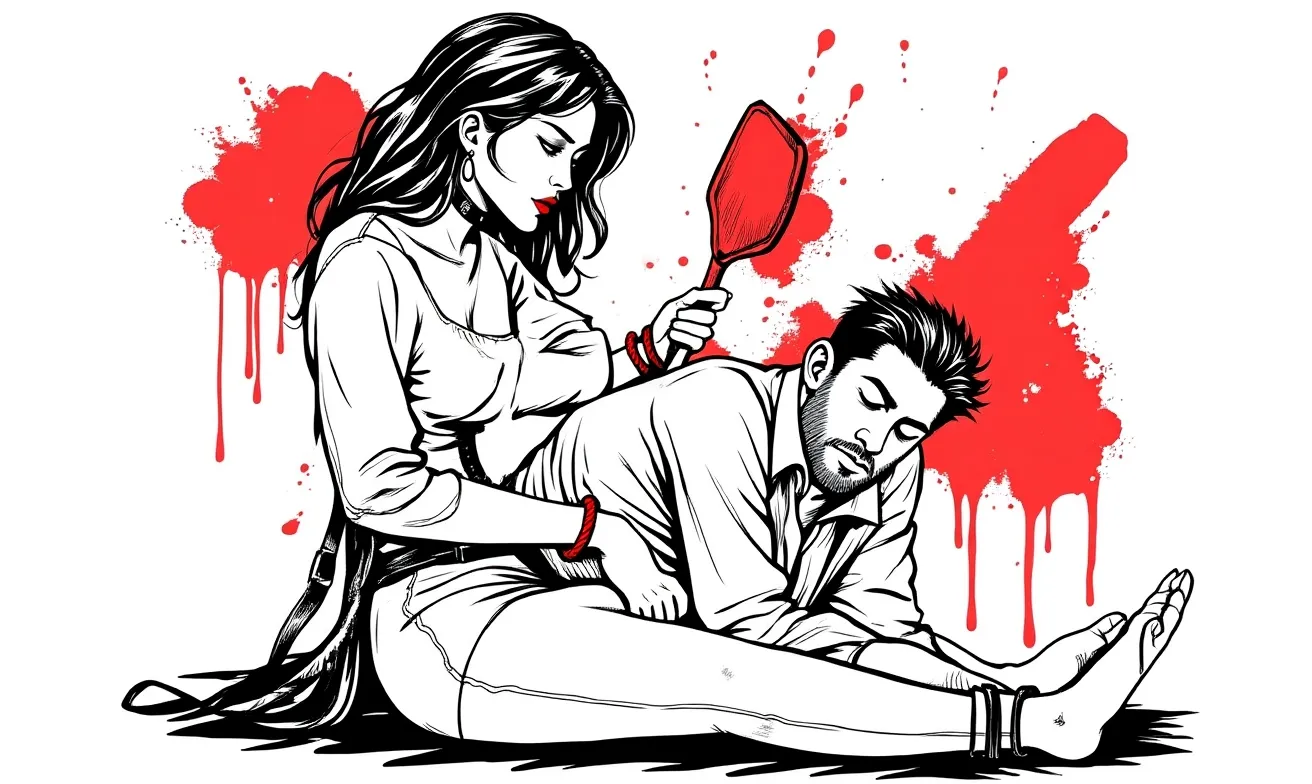
Tamer: "Since you think the paddle is a joke, we're doing fifteen. You count. You miss a number or forget my title, we start at one. Hard cap is thirty regardless of resets. Understood?"
Brat: "Whatever. Start swinging."
[Firm swat.]
Brat: "One."
Tamer: "One what?"
Brat: "One, Sir."
[Swat.]
Brat: "Two, Sir."
[Tamer waits five seconds, then swat.]
Brat: "Four — I mean three. Three, Sir."
Tamer: "Wrong. Back at one. Deep breath. Color?"
Brat: (steadier) "Green, Sir."
Tamer: "Good. Settle."
[Tamer waits until the brat's shoulders drop, then continues. The reset is the lesson — the impact is the venue.]
When Does Brat Taming Go Wrong?
Brat taming is a high-wire act. The fun side and the harm side are close together. Three failure modes to watch for:
- The brat escalates past the scene. If they start hitting back for real, using actual personal insults, or showing genuine distress, stop the scene. Bratting is roleplay; if it becomes a real argument, the BDSM dynamic is over and the next step is regular conversation, not more taming.
- The tamer over-corrects. If you notice yourself genuinely angry, frustrated, or wanting to "teach them a lesson" for real, you are no longer taming, you are retaliating. Pause for five minutes, drink water, decide whether to continue. A tamer who loses composure loses the dynamic.
- Funishment crosses into real punishment. If the consequences stop being fun for the brat — if they go quiet for hours afterward, if they avoid eye contact the next day, if they specifically say a kind of correction did not feel like play — recalibrate. Drop the tier, change the tactic, or take a break from brat taming for a few weeks. The dynamic should leave both partners wanting more, not bracing for the next round.
FAQ
A brat tamer responds to a bratty sub's playful resistance with controlled, deliberate corrections that turn defiance into a scene beat. The job is not to punish or break the sub — it is to meet the bratting with steady, creative authority so the dynamic stays fun. Good brat tamers diagnose the type of bratting they are dealing with (provocation, testing, performance, drop, or princess energy) and pick a response that fits.
In a typical D/s dynamic, the submissive seeks compliance and finds peace in obedience. A brat finds connection through resistance — they want to see their dom react, push back, and prove they can hold the dynamic under friction. Brat taming is the response style built for that. The corrections are usually "funishments" (consequences both partners find fun) rather than real punishments.
Watch what they are actually doing. A provocateur smirks and pokes — meet that with fast verbal control. A tester pushes small rules — meet that with predictable, consistent corrections. A performer plays it big — meet that with controlled attention or audience withdrawal. A drop-brat goes mouthy when overstimulated — pause and stabilize before continuing. A princess refuses with entitlement — make luxury conditional, not free.
Pause the scene. The whole point of brat taming is that the tamer stays the calm center of the storm. If you find yourself genuinely angry — not playfully strict, but actually frustrated — you are no longer taming, you are retaliating. Step out of role, take five minutes, and decide whether to resume or move to a regular conversation. A brat will not respect a tamer who loses control; they will lose interest or get hurt.
You can play, but light scenes only. Effective brat taming relies on knowing how your partner pushes, where their real-life insecurities live, and what kinds of corrections actually feel like fun for them. Stay in Tier 1 (verbal commands, simple postures, no restraints, no impact play) until you both feel calibrated — usually after several negotiated scenes together. Move to Active or Edge tiers only after you have tested your safe-word system and debriefed at least a handful of scenes.
It depends on what the bratting touches. Many trauma survivors find brat dynamics very healing — they reclaim agency by choosing when to resist and when to yield. But corrections that mimic real critical voices from someone's past, or "humiliation" that hits actual insecurities, can be destabilizing. Talk explicitly about what is in-scene language versus what would feel real. When in doubt, work with a kink-aware therapist before adding heavier scenes.
Sources & Further Reading
Research
- Newmahr, S. (2010). "Power struggles: Pain and authenticity in SM play." Symbolic Interaction, 33(3), 389–411.
- Wismeijer, A. A. J., & van Assen, M. A. L. M. (2013). "Psychological characteristics of BDSM practitioners." Journal of Sexual Medicine, 10(8), 1943–1952.
- Sagarin, B. J., Cutler, B., Cutler, N., Lawler-Sagarin, K. A., & Matuszewich, L. (2009). "Hormonal changes and couple bonding in consensual sadomasochistic activity." Archives of Sexual Behavior, 38(2), 186–200.
- Joyal, C. C., Cossette, A., & Lapierre, V. (2015). "What exactly is an unusual sexual fantasy?" Journal of Sexual Medicine, 12(2), 328–340.
Books
- Easton, D., & Hardy, J. W. (2003). The New Bottoming Book. Greenery Press.
- Easton, D., & Hardy, J. W. (2003). The New Topping Book. Greenery Press.
- Califia, P. (1994). Public Sex: The Culture of Radical Sex. Cleis Press.
- Harrington, L. (2012). Playing Well With Others. Mystic Productions Press.
Community & Professional Resources
- NCSF — National Coalition for Sexual Freedom.
- Kink Aware Professionals (KAP) directory — Find a kink-knowledgeable therapist.
- Network La Red — Support for partner abuse in LGBTQ+, kink, and polyamorous communities.
When to Seek Professional Help
If brat dynamics in your relationship keep landing as real arguments, if the bottom shows signs of withdrawal or fear after scenes, or if either partner finds themselves looking forward to a scene primarily to retaliate — pause brat play and reach out to a KAP-listed therapist. As an educator I teach the mechanics; clinicians help process the patterns underneath.
Related Resources
BDSM Brat: Complete Guide
What a brat is, why people identify with the role, and how the dynamic works.
Brat Princess Guide
The princess-coded variant of brat dynamics.
CNC Roleplay: 25 Scenarios + Scripts
For couples ready to graduate from brat taming to consensual non-consent.
Submissive Training Tasks
50 tasks that build structure outside of brat scenes.
BDSM Aftercare Guide
Aftercare is non-negotiable after edge-tier brat scenes.